Op-Ed: Scripted to fail — Europe’s critical minerals blind spot
Europe’s ambitions for critical raw materials are clear. The continent wants to become acceptably self-sufficient in mining, processing, and recycling. Yet, when confronting global competition, the narrative is invariably self-defeatist: “We lack China’s mineral processing capacity.” “We lack America’s investment trade leverage.” “We lack the vast resource endowment of Africa, Australia, and South America.”
If Europe finds itself struggling to secure the materials required for the energy transition, the narrative often tends toward simply being outmatched.
But this explanation is fundamentally flawed. Europe’s critical minerals bottleneck is not a crisis of capability. It is a systemic choice. Europe has the tools, it simply chooses not to deploy them.
Let’s call it what it is: Scripted Innovation Each year, the European Union spends approximately €380 billion annually on research and development (R&D). There is ample evidence to show that every euro invested generates up to 1100% in total economic return.
As home to world-class universities, research institutes, engineers, and scientists, Europe certainly has the intellectual capital needed to compete. Yet despite this, Europe repeatedly finds itself reacting to technological and industrial developments rather than shaping them.
The question is why?
Part of the answer lies in how Europe chooses to fund innovation. Over the past two decades, European research funding has become increasingly mission-oriented, directing funding strictly toward predefined objectives: climate action, energy efficiency, digital transformation, circular economy initiatives, and other strategically important goals.
Of course there is nothing inherently wrong with this approach, and in many respects, it has been highly successful. But mission-oriented funding excels at solving recognised problems. The thing is, truly transformative innovations almost always emerge from problems that have not yet been recognised (it’s the very definition of novelty). By forcing innovation to stay safely within preferred thematic boundaries, Europe creates a framework that struggles to accommodate the unpredictable, out-of-the-box experimentation where real novelty is born.
Case in point: Looking at recent innovations in sodium-ion batteries, which are attracting massive industrial interest as a way to bypass lithium constraints. Imagine proposing a major sodium-ion battery program twenty years ago, when lithium-ion technology was already emerging as the dominant pathway for energy storage. Many evaluators would have reasonably questioned the logic of investing in an “inferior alternative” to lithium.
From the perspective of the time, such scepticism would have been entirely rational. The problem is that innovation does not operate according to today’s assumptions. Technologies that look redundant or commercially irrelevant suddenly become strategic lifelines when geopolitics shift, supply chains become concentrated or market conditions change.
Efficiency vs. optionality
This structural divergence between Europe’s scripted alignment and a more open-ended approach is laid bare in global patent and R&D data (Figure 1). The numbers expose the literal cost of choosing efficiency over optionality.
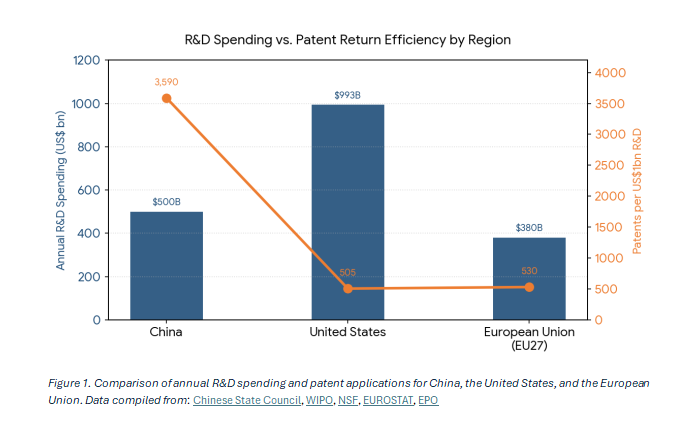
On an equivalent R&D spend of roughly $500 billion, China’s ecosystem shatters the curve, yielding nearly 1.8 million patent applications. That translates into more than 3,500 patents per $1 billion invested in R&D, or 250% more than the European Union and United States combined!
Naturally, critics like to dismiss this towering patent volume as a symptom of low-quality, low-scrutiny filings. Speak to any researcher, and they can point to the relentless trove of suspicious journal invitations and mass-produced papers in their spam folder as proof of this volume-first approach.
It is easy to look at that noise and assume the patents are no different. But dismissing this as mere “low-quality padding” is a massive (and expensive) strategic error. When viewed through the lens of industrial strategy, this metric tells us something else entirely. It is the literal cost that every taxpayer pays for optionality.
For China, it’s a clear numbers game. Absorb the economic inefficiency of thousands of speculative, redundant filings to ensure that when a global shift occurs, you already hold the keys to success. In contrast, by forcing research to pass through rigid policy filters, Europe may clear away speculative “waste”, but it accidentally filters out the very redundancy needed to catch tomorrow’s surprise bottlenecks.
The reality of control
Critical raw materials provide perhaps the ultimate proof of this blind spot. Two decades ago, graphite processing, rare earth separation, lithium refining, and battery precursor supply chains occupied almost no space in mainstream European policy discussions. Today, they sit at the absolute centre of industrial strategy, defence planning, and geopolitical competition.
China invested heavily in many of these capabilities long before they became fashionable. Europe largely did not. As a result, Europe became highly innovative in technologies that use critical raw materials, whilst China became highly innovative in technologies that control them.
The distinction matters. Control over supply chains rarely comes from discovering a new metal. More often, it comes from investing in capital-intensive engineering challenges like processing, refining, separation and recycling. These activities aren’t always viewed as glamorous, and they certainly don’t fit traditional definitions of “breakthrough innovation”, but innovation itself is a dynamic concept that changes with need.
The bottom line
This raises an uncomfortable question for European policymakers. Have we become too focused on funding what appears innovative today, whilst overlooking the foundational capabilities that may become strategically decisive tomorrow?
Europe does not suffer from a lack of talent, scientific excellence, or capital. It suffers from a narrowing definition of innovation itself. Millions of brilliant minds working on a script written by a few.
In a game where every investment yields truly exponential economic returns, the real winners will not necessarily be those who best solve today’s problems, but those who buy enough optionality to recognize tomorrow’s unscripted opportunities.
Dr. Nicholas Vafeas is an economic geologist specializing in critical raw materials, mineral supply chains, and energy policy.
More News
{{ commodity.name }}
{{ post.title }}
{{ post.date }}
Comments