Peru election too close to call as vote tally drags on
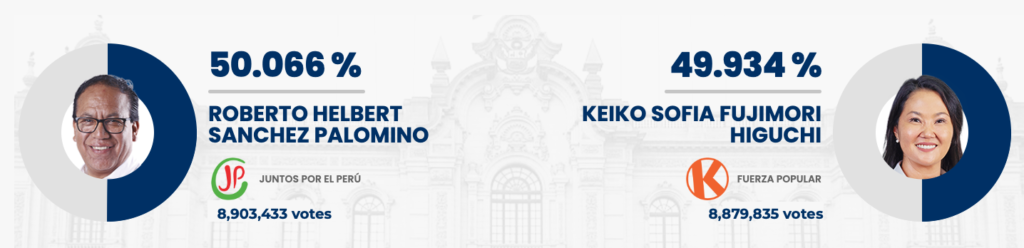
Peru’s presidential election remained too close to call as vote counting entered its final stages, with left-wing candidate Roberto Sánchez holding a razor-thin lead over conservative rival Keiko Fujimori.
With 95.8% of ballots counted, Sánchez had secured about 50% of the vote compared with Fujimori’s 49.9%, according to Peru’s ONPE electoral authority. Fujimori led early returns and exit polls, but Sánchez gained ground as votes from rural regions were added to the tally. The winner will become Peru’s ninth president in a decade.
“Peru’s markets have largely become accustomed to political instability,” analysts at GEM Mining Consulting said, warning that a Sánchez victory could still trigger a “strong adjustment” in the country’s bonds and currency.
The uncertainty is rattling investors and raising questions about the future of billions of dollars in mining investment in the world’s third-largest copper producer. Business confidence fell in April to its lowest level in nearly two years, according to Peru’s central bank, while the country’s bonds and currency have lagged regional peers in recent weeks. The election comes as strong copper and gold prices were expected to support further growth in mining investment after spending reached about $6 billion last year.
Mining stakes
The two candidates offer sharply different visions for Peru’s economy. Fujimori, a veteran figure in Peruvian politics and daughter of former president Alberto Fujimori, supports the country’s market-oriented framework.
Sánchez, a close ally of jailed former president Pedro Castillo, has pledged broad economic reforms, including rewriting Peru’s business-friendly constitution, reviewing mining tax agreements and redistributing more wealth to rural communities.
Peru’s economy has expanded by roughly 3% annually since the pandemic, driven largely by mineral exports despite recurring political turmoil in Lima. Mining accounts for about 60% of exports and supports operations run by companies including Glencore (LON: GLEN), Anglo American (LON: AAL) and Freeport McMoRan (NYSE: FCX) and MMG.
In March, Fortescue (ASX: FMG) completed its C$139-million acquisition of Alta Copper and its Cañariaco project, an open-pit development expected to produce 140,000 tonnes of copper annually.
Sánchez has also proposed phasing out open-pit mining, the dominant extraction method used by most large mines in Peru, while suggesting the use of international reserves for social spending.
Investors are weighing additional proposals affecting the sector, including legislation that would reduce the time companies can hold unused mining concessions and efforts to revoke Southern Copper’s (NYSE: SCCO; LON: SCCO) long-delayed Tía María project licence, which was reinstated in April.
The election highlights the tension between Peru’s political volatility and the mining sector that has helped sustain economic growth through years of upheaval. While investors have repeatedly navigated changes in government, the outcome could influence the regulatory and investment climate for one of the world’s most important sources of copper, gold and other critical minerals.
ONPE said a full vote count is expected to be completed by July.
{{ commodity.name }}
{{ post.title }}
{{ post.date }}
Comments