Water shortages are quietly killing mining projects — new tech rises to fix it
There’s a moment that keeps replaying in the mining sector. A geologist presents a promising discovery — strong grades, favourable jurisdiction, scalable resource.
A lot of time and resources can be deployed before the key question comes up that stops everything: Where is your water coming from?
Increasingly, there is no good answer. And increasingly, that answer is killing projects before they can ever reach production.
Houston, Texas-based Justin Vandenbrink, vice president of mine water strategy at consultancy firm Woodard & Curran, told MINING.COM that what comes up consistently is where water strategy, permitting, and mine economics collide.
The shift no one was watching
For decades, water sat at the periphery of mining analysis — a logistical consideration, but rarely a dealbreaker. That has changed.
“Operators tend to model water as a technical problem — build the treatment system, manage the discharge — but they don’t model it as a schedule problem,” Vandenbrink said. “A water permit in the western US can take two to four years. Sometimes longer. If that timeline wasn’t baked into the project schedule from day one, you already have a problem you haven’t discovered yet.”
The warning reflects a broader shift underway across the mining industry. Water scarcity is increasingly colliding with permitting timelines, community opposition and rising demand from agriculture, energy production and artificial intelligence data centres.
According to the Bradshaw Institute for Minerals and Mining, water has evolved from a secondary operational concern into a major environmental and economic constraint.
Vandenbrink said how many companies frame their own risk is a blind spot. Water permitting is often treated as a downstream environmental task rather than a core development issue tied directly to project schedules, financing and long-term economics.
“The ore grade is good, the capital raise is underway, the technical team has done solid work on the process plant and the tailings facility,” he said. “I’ve watched projects with strong ore bodies and good financing stall because the water story wasn’t credible — to regulators, or to the community.”
But the water permit — the actual regulatory authorization to discharge, to dewater, to affect downstream users — gets treated as a downstream task, he said.
Vandenbrink sees a regular pattern when a project is in development.
“What nobody models is that the lead agency has a backlog. That a downstream water rights holder has filed a formal objection. None of those things are unusual. All of them are foreseeable.”
This shift reflects a deeper reality. Only about 3% of Earth’s water is freshwater, and a fraction of that is readily accessible.
Meanwhile, demand is accelerating — not just from mining, but from agriculture, energy production, and increasingly, data centers powering artificial intelligence.
The result is a convergence of pressures around a single finite resource. Water is no longer just an input. It is becoming a constraint.
From resource to risk
The implications are beginning to ripple outward. Credit agencies are starting to factor water availability into national and corporate risk profiles. Competing industries are openly deflecting scrutiny by pointing to each other’s consumption. Governments are reassessing water security as a strategic priority.
And in mining, where water is essential at every stage — from drilling to processing — its absence can quietly derail even the most promising assets.
Projects don’t fail on water in dramatic fashion. They stall. They get delayed. They become uneconomic. Eventually, they disappear.
By the time the postmortem is written, water is often buried deep in the fine print.
A new approach
Most of the technology adoption Vandenbrink sees in mine water is driven by permitting pressure and closure liability — not just efficiency. He pointed out that closed-loop recycling is a potential solution — reducing or eliminating discharge entirely by reusing process water, but that too has constraints.
Out of this growing constraint, a new technological approach is emerging — one that challenges a fundamental assumption about water itself.
Instead of sourcing water from rivers, aquifers, or desalination, some technology companies are beginning to generate it directly from the air. The concept is deceptively simple: treat air as a resource.
There is a vast amount of water suspended in the atmosphere — estimated to be several times the volume of all the world’s rivers combined at any given moment. Unlike groundwater, which can take centuries to replenish, atmospheric water cycles rapidly, turning over in a matter of days.
In industry terms, it represents a move from “slow water” to “fast water.”
Genesis Systems, a US-based firm founded in 2017, is among the companies leading this shift. Its systems extract atmospheric moisture and convert it into potable water using proprietary materials designed to capture and release water vapor efficiently.
“The data center industry, the cattle industry, and the mining industry are all competing for this finite scarce resource. Water is no longer on the periphery,” Genesis Systems’ CEO David Stuckenberg told MINING.COM in an interview. “We’ve moved from water being an afterthought to a forethought.”
Genesis’ ‘WaterCube’ systems — some capable of producing over 1,000 gallons per day — generate potable water directly from air, operating independently of pipelines or grid infrastructure.
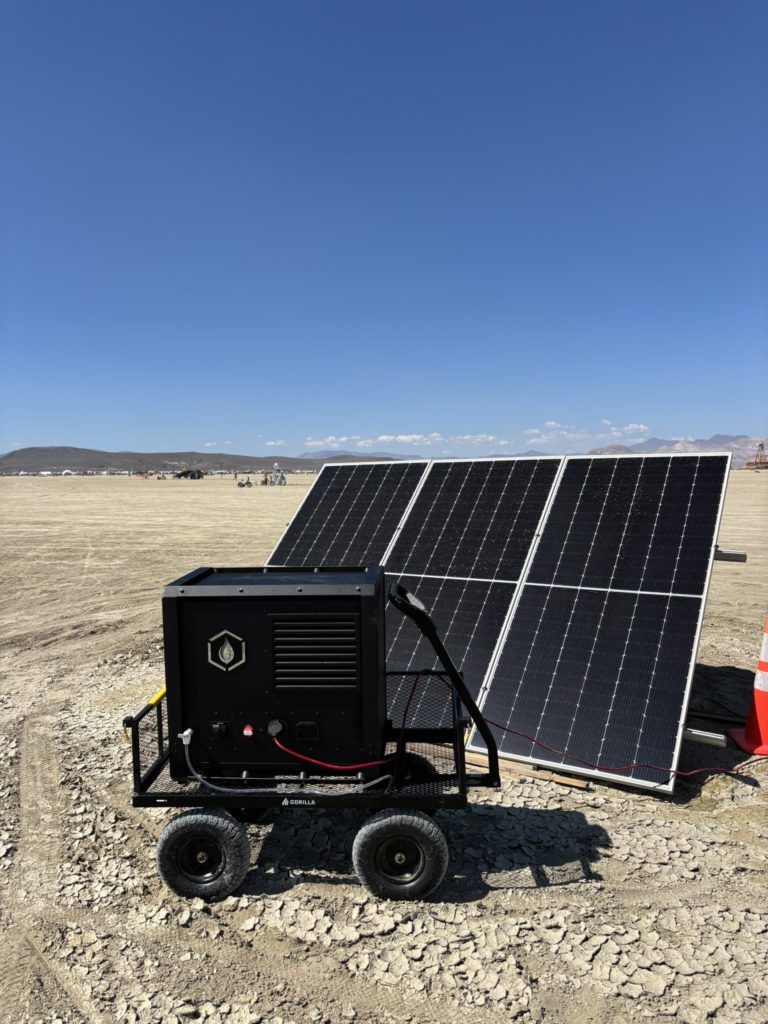
“If we pull water out of the ground, it takes 90 years to 900 years to replenish. The atmosphere replenishes in days,” Stuckenberg said.
The systems have already been deployed in demanding environments, including disaster response scenarios and military operations where traditional supply chains are unreliable or contested.
Now, mining is emerging as a next frontier, and WaterCubes have already been deployed at mining sites, Stuckenberg said.
Another startup has emerged in the space: California-based Atoco’s technology also confronts water shortages by pulling it from the air.
“There’s a new realization of the vulnerability and security risk of centralized water systems,” Atoco CEO Samer Taha told Bloomberg. “This becomes absolutely essential in alleviating the problems we are facing on our planet in terms of water scarcity.”
The mining industry has always been shaped by constraints — ore grades, jurisdictional risk, energy costs. Water is now joining that list in a far more prominent way.
At the same time, it is opening the door to a new class of solutions and, potentially, a new investment theme.
In the years ahead, the defining question for many mining projects may not be what lies beneath the ground, but whether there is a viable path to sustaining operations above it.
Those that solve the water problem—whether through traditional means or emerging technologies — will move forward. Those that don’t may never make it past the feasibility stage.
And in an industry where billions can hinge on a single constraint, water is quickly becoming the one that matters most.
More News
Bomb attack damages Ecuador mining agency probing illegal gold
It’s the second blast in recent weeks affecting Arcom offices.
June 29, 2026 | 12:28 pm

{{ commodity.name }}
{{ post.title }}
{{ post.date }}
Comments