Congo in talks with private trainers for guard to protect mines
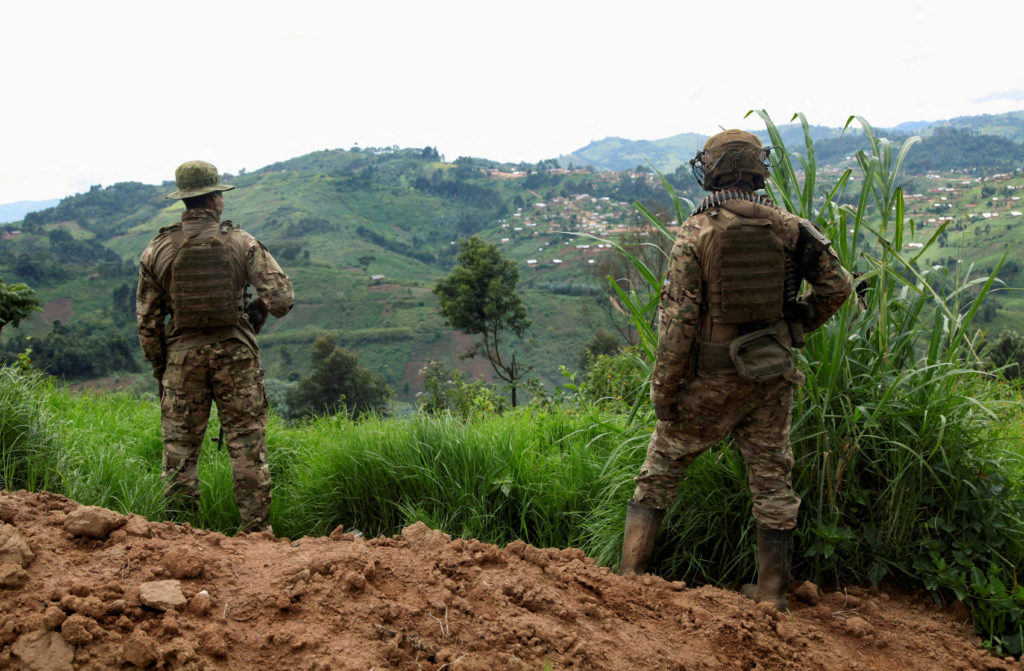
The Democratic Republic of Congo’s government is in talks with a private company to train more than 20,000 armed guards to protect its mines, as part of an effort to clean up the reputation of the industry there.
The guards will protect large-scale commercial operations, help formalize sites worked by artisanal miners who use rudimentary tools to dig ore, and improve traceability of mineral exports, according to the head of the General Inspectorate of Mines, who didn’t identify the private training firm. The new force will eventually replace all police and soldiers currently active at mining and processing sites.
Congo has some of the world’s richest deposits of copper, cobalt, tin, tantalum, gold, lithium and zinc. But artisanal miners — sometimes protected by soldiers — often operate without permission, including on concessions belonging to international investors. Minerals are also frequently smuggled out of the country, particularly in war-torn areas in the east.
“Things are moving along well with them,” Inspector General Rafael Kabengele said of the company in an interview last week in the mining hub of Lubumbashi. “The principle has been agreed upon.”
A decree authorizing the unit’s creation should be published soon, said Kabengele, who took over the influential post in January.
Barrick Mining Corp. operates a massive gold mine in the northeast, while Glencore Plc, CMOC Group Ltd. and Zijin Mining Group Co. Ltd. are among key players in a booming copper industry in the southeastern Katanga region.
The General Inspectorate, which is part of the mines ministry, earlier this year said it will invest $100 million in the guard with funding from the US and United Arab Emirates. Congo signed a strategic partnership with the Trump administration in December that provides US companies with preferential access to some Congolese mining and infrastructure projects.
While the US government said it’s not participating in the initiative, Kabengele said Washington is “ready to help, truly help” with the project. The US State Department told Bloomberg this week that the US “is not involved in any way and does not have plans to provide funding” for the force.
Guard training
Training should begin by September, with a first battalion expected to be deployed to Katanga in January, according to Kabengele. The trainers aren’t linked to Erik Prince, a Trump ally and founder of private military contractor Blackwater, whose companies have worked in several sectors in Congo over the years, Kabengele said.
He also said he’d prefer that employees of the existing mining police don’t join the guard.
The General Inspectorate recently intervened in a dispute on a permit held by a Eurasian Resources Group subsidiary, which is one of the world’s top suppliers of battery metal cobalt, after artisanal miners occupied a large part of the license. A military mission last month removed the intruders, who claimed to have government authorization to clean up a riverbed within the concession that contains most of the ERG unit’s remaining reserves.
This is a “typical example” of the matters the General Inspectorate and mining guard will resolve, according to Kabengele, who said his team’s findings have been submitted to judicial authorities. Congo’s artisanal miners “may have the right to mine, but not like that,” he said.
(By William Clowes and Michael J. Kavanagh)
{{ commodity.name }}
{{ post.title }}
{{ post.date }}
Comments