American Ocean Minerals finishes first offshore exploration mission in Cook Islands
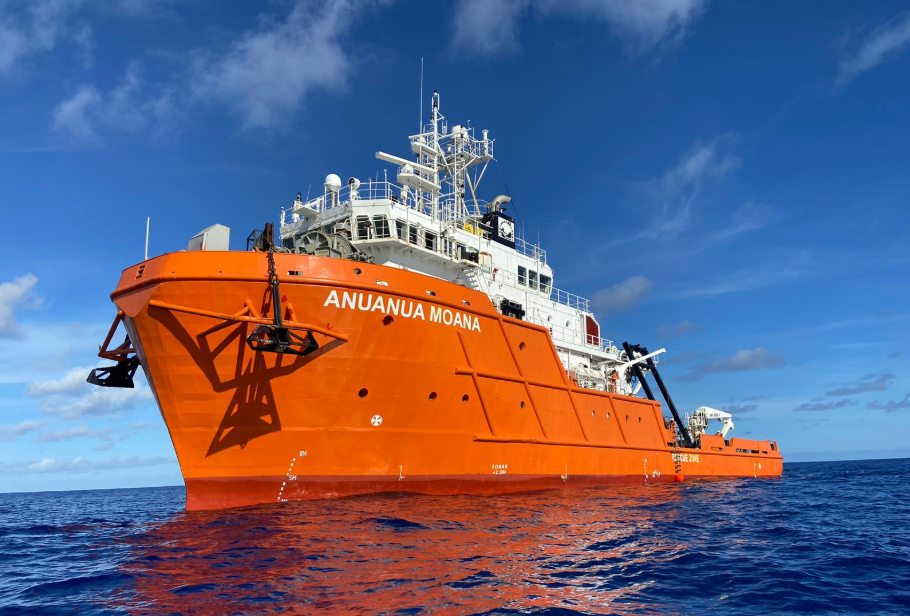
American Ocean Minerals Corporation (AOMC) has completed Expedition 7, a research mission to support environmental baseline studies required for future deep-sea mineral exploration and development in the Cook Islands.
In April, AOMC signed a definitive merger agreement with Odyssey Marine Exploration, a deal expected to create a US-controlled deep-sea critical minerals company valued at approximately $1 billion, in the companies’ push toward commercial seabed mining.
Originally built in 2007 and acquired by AOMC in 2022, the 196-foot Anuanua Moana has been refurbished to serve as a central offshore platform for exploration and environmental monitoring.
AOMC is building a portfolio across the Cook Islands’ exclusive economic zone and US-regulated international waters, including the Clarion-Clipperton Zone and the Penrhyn Basin, with interests in two licensed exploration projects in the Pacific.
In US-regulated waters, the company has met compliance requirements for two exploration applications under the Deep Seabed Hard Mineral Resources Act, covering more than 1.4 billion tonnes of inferred resources.
Expedition 7 was conducted over approximately three weeks aboard the MV Anuanua Moana, a proprietary research vessel advancing critical deep-sea environmental and exploration programs across its operating areas.
For the campaign, the Anuanua Moana was deployed as a centralized research and exploration asset across AOMC’s portfolio, including Moana Minerals’ El3 licensed area. The exploration license, granted by the Cook Islands Seabed Minerals Authority, is held by OML through its subsidiary Moana Minerals Ltd.
The team completed 53 sites, successfully deployed and recovered 60 box cores and 62 multicores, and collected 4,059 physical samples for detailed analysis that will help refine and strengthen the existing polymetallic nodule resource estimate within MML’s EL3 license area.
Transitioning deep-sea mineral assets from exploration to potential commercial harvesting requires multi-year environmental baselining, resource definition, and technical studies, which are nearing completion, the company said.
The data collected during Expedition 7 is expected to contribute directly to Moana Minerals’ ongoing Environmental Impact Statement (EIS) planned for the first half of 2027 and pre-feasibility study (PFS) on track for completion in the second half of this year across MML’s license area, as well as future engagement with Cook Islands regulators.
“AOMC is building a platform founded on disciplined execution, rigorous environmental standards, and dedicated infrastructure,” AOMC chairman and former Rio Tinto CEO Tom Albanese said in news release.
“The successful completion of this campaign reinforces the strategic value of the Anuanua Moana. It enables us to collect consistent, high-quality data on a recurring basis, reduce dependence on third-party vessel availability, and advance the regulatory work required to evaluate these resources responsibly,” Albanese said.
“These integrated workstreams reflects AOMC’s view that responsible development requires environmental science and resource assessment to advance in parallel.”
The expedition integrated sediment physico-chemistry with quantitative macrofaunal, meiofaunal, foraminiferal, and molecular environmental DNA data to establish baseline ecological conditions and natural variability across representative deep-sea habitats, the company said.
Additional datasets were collected where feasible, including bathymetry, water-column biomass, and surface marine observations.
“This was an exceptional campaign that reflects the capability and discipline of the entire team,” Ocean Minerals CEO Hans Smit said. “In three weeks, the team…generated a substantial new body of data that enhances our understanding of the deep-sea ecosystem within the Moana 1 Project Area.”
“The combination of biological, chemical, physical, and geological sampling is exactly the kind of integrated science required to assess natural variability, understand ecosystem structure, and support evidence-based environmental management.”

{{ commodity.name }}
{{ post.title }}
{{ post.date }}
Comments