Copper price: BMI hikes forecasts – structural deficits to bring $17,000 next decade

Copper trading in New York hovered just below the $14,000-a-tonne level on Thursday, with the most active September contract last changing hands at $6.32 per pound ($13,900 a tonne), holding near three-week highs as production troubles in Chile and softer US inflation data lent support.
The bellwether metal set an all-time high above $6.60 a pound in June and is up more than 15% over the past year, with LME three-month copper averaging $13,150 a tonne so far in 2026.
The rally has BMI, a unit of Fitch Solutions, reaching for its eraser. In a report released this week, the research house lifted its 2026 average copper price forecast to $12,700 per tonne, up from $11,900 previously, citing converging supply-side pressures, tariff-driven tightness and AI-fuelled optimism that “continue to propel the red metal to successive record highs.”
BMI’s 2026 number still sits below the Bloomberg analyst consensus of $13,007 and trails calls from the likes of Macquarie, which last week raised its own 2026 average to $13,165 a tonne even while arguing the rally is running ahead of fundamentals, and Goldman Sachs, which is holding its 2026 forecast at $12,650 despite predicting a 490,000-tonne surplus this year.
Where BMI breaks from the pack is further out. The firm sees copper averaging $13,500 a tonne in 2028, $15,000 in 2029 and $15,800 in 2030 – against Bloomberg consensus of $12,500, $13,772 and $13,500 respectively – before reaching $17,000 per tonne in 2035 as the structural deficit takes hold:
“Over the longer term, we expect prices to reach $17,000/tonne in 2035, as the structural deficit persists due to a strong demand outlook as the green transition accelerates towards the latter half of the decade.”
That is comfortably the most bullish long-term call among major forecasters. Macquarie pegs the long-term incentive price at just $10,200 a tonne in 2025 dollars and sees a floor near $11,000 by the third quarter of 2027, while UBS’s most recent upgrade topped out at $13,000 by end-2026. Even the bulls at trader Traxys, whose CEO expects $15,000 copper within 24 to 36 months, stop short of BMI’s 2035 number. Chile’s copper commission Cochilco lifted its own outlook in May to $5.55 per pound ($12,235 a tonne) for 2026 and $5.10 for 2027.
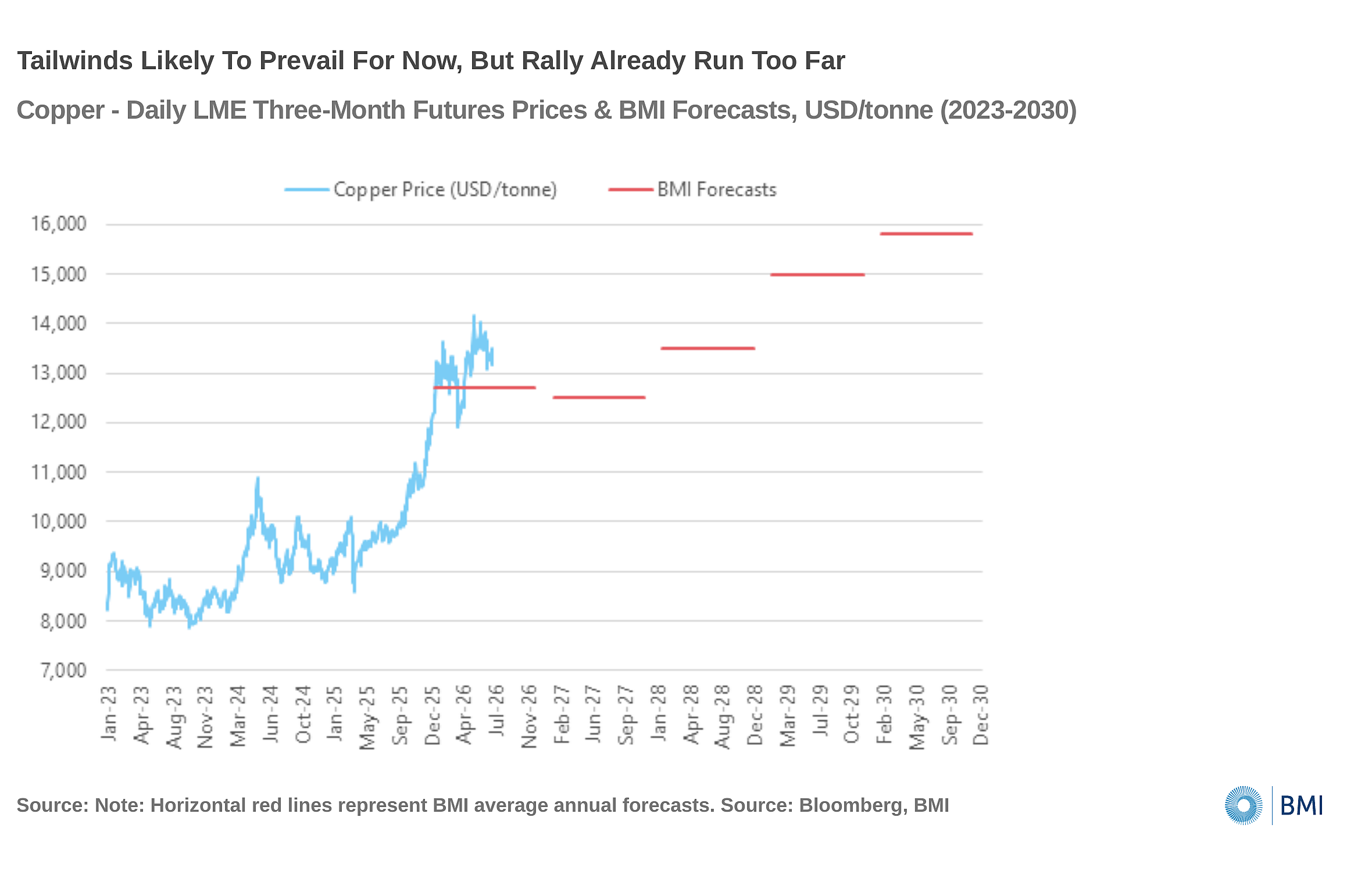
Rally “already run too far”
For all its long-term enthusiasm, BMI is quick to point out that the near-term picture does not justify current prices. The firm expects copper to “remain caught between macro headwinds and tariff uncertainty” in the second half, with the market “acutely exposed to further volatility and highly sensitive to Middle East jitters.”
“We still view the current price rally as already extending beyond what the fundamentals alone would suggest,” BMI said, pointing out that the market remains in surplus this year – albeit a narrowing one, at 93,000 tonnes versus the 212,000 tonnes projected for 2025.
The US tariff decision remains the most immediate directional catalyst, according to the report. The Comex-LME spread was running at a maximum of just around $680 per tonne at the start of June – nowhere near the $2,937 record set at the end of July last year – suggesting the market is tilting towards a delay in implementation rather than outright cancellation. Tariff-driven distortion has nonetheless kept CME copper stocks at record highs, up 34.9% since the start of the year.
BMI flags sulphur and sulphuric acid – indispensable to leaching and SX-EW processing, which accounted for 21% of global mine output in 2024 – as a newly critical vulnerability, with Middle East shipments through the Strait of Hormuz squeezed and China halting acid exports from May 2026.
On the supply side, BMI cut its global mine production growth forecast for 2026 to 2.4% from 2.8%, mainly on downward revisions to Chile’s outlook and continued output constraints at Grasberg and Kamoa following major operational incidents in 2025.
Deficits from 2027
From 2027 the balance flips into a 66,000-tonne deficit, and the shortfalls widen every year thereafter to nearly 1.5 million tonnes by 2035 on BMI’s numbers.
The green energy transition remains the backbone of that demand story. Battery electric vehicles require approximately 53.2kg of copper, more than double the 22.3kg in conventional cars, according to the International Energy Agency, while offshore wind uses 8,000kg per megawatt versus 1,150kg for coal-fired plants.
AI is the newer pillar. Data centres require 20–40 tonnes of copper per megawatt of applied power, according to the Copper Development Association, with the metal used across power distribution, grounding and cooling infrastructure. While not the sole driver of copper’s 2026 run, BMI expects AI-driven sentiment “to continue to shape, if not dominate, the narrative in the coming years.”
More News

{{ commodity.name }}
{{ post.title }}
{{ post.date }}
Comments