Edinburgh researchers license tech to extract gold and copper from electronic waste
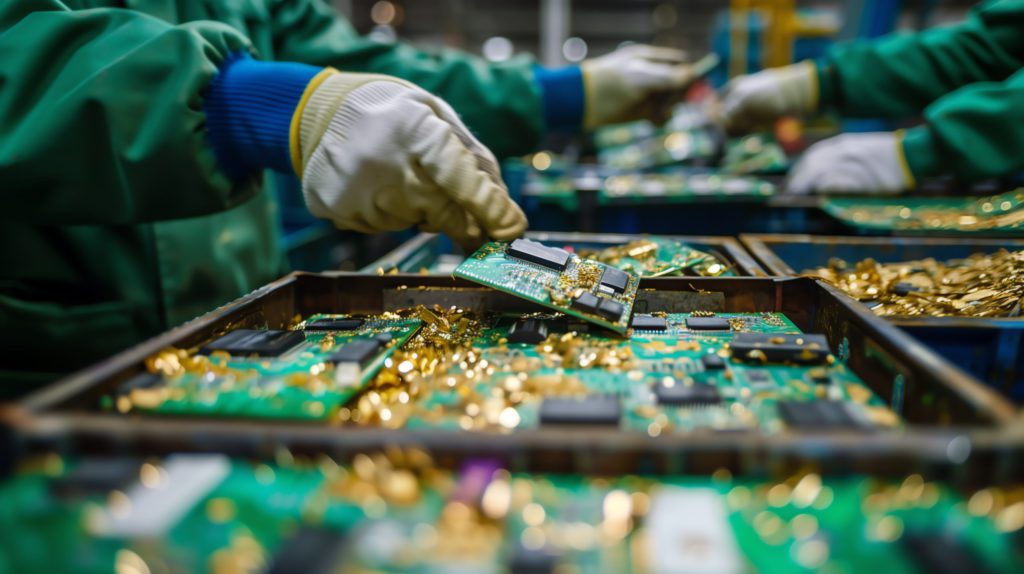
The University of Edinburgh has licensed a gold and copper recovery process to mineral processing company Lithium Universe, enabling cleaner extraction of high‑value metals from electronic waste.
Developed by Professors Jason Love and Carole Morrison in the School of Chemistry, and commercialized with support from Edinburgh Innovations, the Gold Copper Diamide Extraction (GCDE) process uses organic compounds to selectively extract metals from discarded electronics.
Under an exclusive agreement, Lithium Universe will deploy and sub‑license the technology globally as part of its expanding precious metals recycling strategy.
E‑waste is one of the world’s fastest-growing hazardous waste streams, projected to reach around 93.5 million tonnes by 2030, but only about 20% is recycled using environmentally sound methods, the University said.
This waste is valuable, as devices and printed circuit boards are rich in gold and copper. At current prices, the gold content of one tonne of typical e‑waste is worth more than $46,000, with copper adding roughly another $2,000, it estimates.
But traditional e‑waste processing relies on furnace smelting above 1,200°C or aggressive leaching, both energy‑intensive and polluting, the University noted. Its GCDE process instead uses low‑temperature hydrometallurgy and small, reusable organic ligands to target metals in sequence, under mild conditions and avoiding cyanide, mercury and organic solvent extraction.
“Electronic waste is effectively a high‑grade ‘urban ore’. Our goal was to design chemistry that can recover those metals selectively and safely, without the energy and environmental cost of smelting,” Love said in a news release.
“The diamide behaves like a molecular magnet for gold. By following with a selective copper step, we can recover two of the most valuable metals in e‑waste with high purity and lower environmental impact.”
Lithium Universe plans to integrate GCDE into its precious metals recycling division, alongside its silver recovery technologies for end‑of‑life solar panels.
“This breakthrough from the University of Edinburgh reinforces the strategic expansion of our precious metals recycling division into high-value recovery technologies,” executive chair Iggy Tan said.
By integrating selective metal recovery with sustainable processing, the company would “strengthen its competitive position in circular-economy solutions for gold, silver and copper recovery,” he added.
{{ commodity.name }}
{{ post.title }}
{{ post.date }}
Comments