Op-Ed: The Arctic won’t save the energy transition

The Arctic has become the latest frontier in the race for critical minerals, but geology alone will not secure the metals needed for the energy transition.
Governments increasingly view the North’s vast deposits of copper, nickel, graphite, rare earths and other strategic minerals as insurance against fragile supply chains and geopolitical uncertainty. Investors see untapped opportunity. Both perspectives contain truth, but they overlook a more difficult reality: discovering minerals is only the first step toward building resilient supply chains.
Too much of today’s debate treats the Arctic as a warehouse of strategic resources waiting to be unlocked. It is nothing of the sort. Every promising deposit must survive an unforgiving sequence of technical, financial, environmental and political tests before it produces a single tonne of marketable material.
That distinction matters because public policy increasingly measures success by resource inventories rather than production. A resource is not a reserve. A reserve is not a mine. A mine is not a supply chain. Every stage requires different capital, institutions and expertise, while Arctic conditions magnify the consequences of even small planning mistakes.
Distance, permafrost, seasonal logistics, limited infrastructure, energy constraints and Indigenous rights make northern projects fundamentally different from those farther south. Mines that appear attractive on paper can quickly become uneconomic once these realities are fully accounted for.
The Arctic’s strategic importance therefore lies not in the quantity of minerals beneath its surface, but in its ability to convert selected deposits into dependable production.
Infrastructure matters more than geology
Mining investors have traditionally pursued the world’s largest deposits. In the Arctic, that instinct can be misleading.
A rich orebody located beside rail, deepwater shipping and reliable power is fundamentally different from an equally rich deposit requiring hundreds of kilometres of new roads, seasonal ports and diesel generation before construction can begin. On paper the projects may appear comparable. In practice, they belong to entirely different economic worlds.
This conversion gap explains why many celebrated critical-mineral discoveries never progress beyond feasibility studies. Exploration success is relatively common. Building competitive mines in one of the world’s harshest operating environments is not.
The strongest Arctic projects will rarely be those with the biggest resource estimates. They will be those capable of overcoming structural disadvantages while delivering competitive products into established markets. In many cases, that means expanding existing mining districts rather than creating entirely new ones.
One Arctic does not exist
The Arctic is often discussed as though it were a single investment destination. In reality, it consists of several distinct mining systems with very different strengths and constraints.
Northern Scandinavia offers perhaps the strongest foundation. Sweden, Finland and northern Norway combine world-class geology with railways, ports, renewable electricity, engineering expertise and mature regulatory institutions. Developers are expanding long-established mining districts rather than building entirely new ones, reducing both capital requirements and execution risk.
Northern Canada and Alaska possess exceptional mineral potential and several successful operating mines, but many new projects remain constrained by logistics. Transportation costs are high, power infrastructure is limited and construction seasons are short. These obstacles do not make development impossible, but they narrow the margin for commercial success.
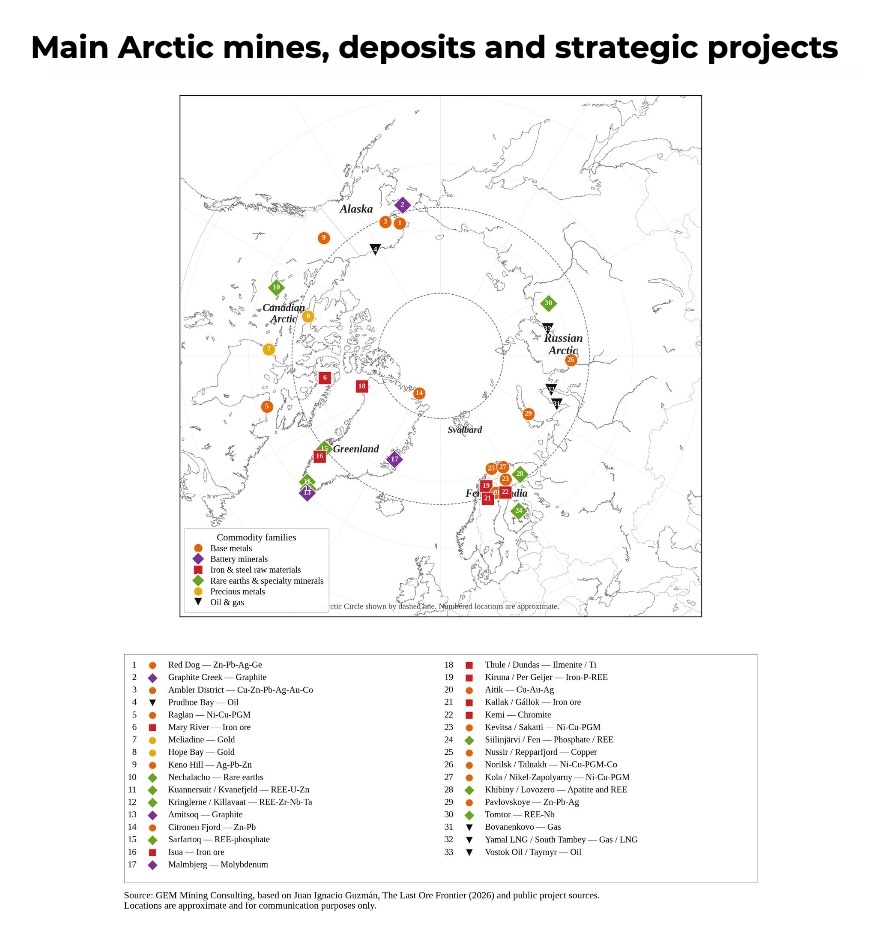
Greenland has attracted growing interest for rare earths, graphite and specialty metals, yet most projects still require major investments in infrastructure, workforce development and processing capacity before they become economically sustainable.
These differences matter because infrastructure often determines project economics more than geology itself.
Politics cannot replace economics
Governments increasingly describe critical minerals as matters of national security, and with good reason. Reliable access to copper, graphite, rare earths and battery metals has become essential to economic competitiveness and defence.
The danger lies in assuming that political importance automatically creates commercial viability.
Subsidies can reduce financing costs. They cannot eliminate poor logistics. Strategic declarations may encourage exploration, but they cannot shorten shipping distances, lower operating costs or build power grids overnight.
Public investment can make an important contribution by funding geological surveys, transportation infrastructure, scientific research and processing capacity. What it cannot do is transform fundamentally weak projects into sustainable businesses.
Markets ultimately demand profitable operations regardless of political enthusiasm.
Licence to operate
Mining companies once measured project risk largely through grades, tonnes and commodity prices. In the Arctic, another factor increasingly determines success: legitimacy.
Indigenous governments and northern communities are not peripheral stakeholders. They are rights holders whose participation shapes whether projects proceed at all.
Projects that earn local support generally move more predictably through permitting, attract stronger investment and experience fewer costly delays. Those that fail to build trust often spend years navigating litigation, regulatory uncertainty and political conflict before construction begins.
This is not simply a legal obligation. It is an economic one.
Successful developers increasingly involve Indigenous communities early, negotiate benefit agreements before engineering is finalized and incorporate traditional knowledge into environmental planning. These approaches reduce uncertainty while strengthening projects over the long term.
Partnership is not a regulatory hurdle. It is one of the foundations of responsible Arctic development.
Environmental resilience is economic resilience
Environmental protection is often portrayed as a cost imposed on mining. In the Arctic, it is increasingly a prerequisite for investment.
Climate change is reshaping the assumptions on which northern infrastructure was built. Permafrost is becoming less predictable, winter roads have shorter operating seasons and water management demands new engineering standards. These risks affect profitability as directly as commodity prices.
That makes robust baseline science indispensable. Companies must understand water quality, biodiversity, permafrost conditions and wildlife before development begins. Strong environmental data reduces uncertainty for regulators, investors and communities alike, while weak science increases the risk of delays, disputes and long-term liabilities.
The same principle applies to mine closure. Arctic projects may operate for only a few decades, but waste facilities and water management systems often require oversight for generations. Closure planning, financial assurance and long-term monitoring must therefore be built into projects from the outset rather than treated as an afterthought.
Critical minerals are supply chains
One of the biggest misconceptions surrounding critical minerals is that opening more mines automatically strengthens national security.
It does not.
A mine produces ore or concentrate. Strategic value is created only after material is processed, refined, manufactured and incorporated into products that industries and governments actually use.
Graphite must be purified into battery-grade material. Rare earths require complex separation before they become magnets for electric vehicles, wind turbines or defence systems. Germanium often depends on zinc production, while cobalt is closely linked to nickel mining. Every critical mineral exists within a much larger industrial ecosystem.
Public policy should therefore focus on building complete supply chains rather than simply increasing the number of mines. The Arctic can strengthen those supply chains where mining is supported by processing capacity, transportation infrastructure and long-term industrial partnerships. Without those links, new production simply creates another isolated source of raw material.
Smarter policy, not bigger subsidies
Governments have an important role to play in Arctic development, but that role is not to make uneconomic projects appear viable.
Public investment delivers its greatest return when it creates assets that benefit entire regions. Better geological mapping lowers exploration risk for every developer. Roads, ports and power systems support both communities and industry. Baseline environmental science improves regulatory certainty, while domestic processing captures more value and reduces dependence on overseas refining.
These are public goods.
Permanent subsidies for projects that cannot compete commercially are something else entirely. Markets eventually expose weak economics regardless of political urgency. Governments should focus on removing structural barriers, not overriding commercial reality.
Knowing when to say no
Perhaps the hardest lesson for policymakers and investors is that not every deposit should become a mine.
Some projects will never overcome their logistical disadvantages. Others may face environmental risks that cannot be responsibly managed or lack the community support necessary for long-term success.
Recognizing those limits is not a sign of failure. It is evidence of discipline.
Every project rejected for sound economic, environmental or social reasons strengthens confidence in those that ultimately proceed. The credibility of Arctic mining will depend as much on the industry’s willingness to decline unsuitable developments as on its ability to build successful ones.
The Arctic deserves better questions
The debate over Arctic mining has become increasingly polarized. One side portrays the region as the solution to the world’s critical-mineral shortages. The other sees development as fundamentally incompatible with environmental stewardship.
Neither position reflects reality.
The Arctic contains extraordinary geological potential, but geology alone has never built a successful mining industry. Mines succeed only when economics, infrastructure, engineering, environmental performance and public legitimacy align over decades.
The energy transition will not justify every Arctic project, nor will the Arctic single-handedly secure the minerals needed for a decarbonized economy. Carefully selected developments, however, can make an important contribution where they strengthen resilient supply chains, respect Indigenous rights, protect fragile northern environments and create lasting public value.
The Arctic is not a warehouse waiting to be emptied. It is a proving ground where every project must earn the right to proceed. Those that do will help shape the next generation of responsible resource development. Those that do not should remain exactly where they are—in the ground.
The future of Arctic mining will not be determined by the mineral wealth beneath the tundra. It will be determined by the quality of the decisions we make above it.
* Juan Ignacio Guzmán is chief executive officer of Santiago, Chile-based Gem Consulting.

{{ commodity.name }}
{{ post.title }}
{{ post.date }}
Comments