Trump launches $12B ‘Project Vault’ to cut China reliance
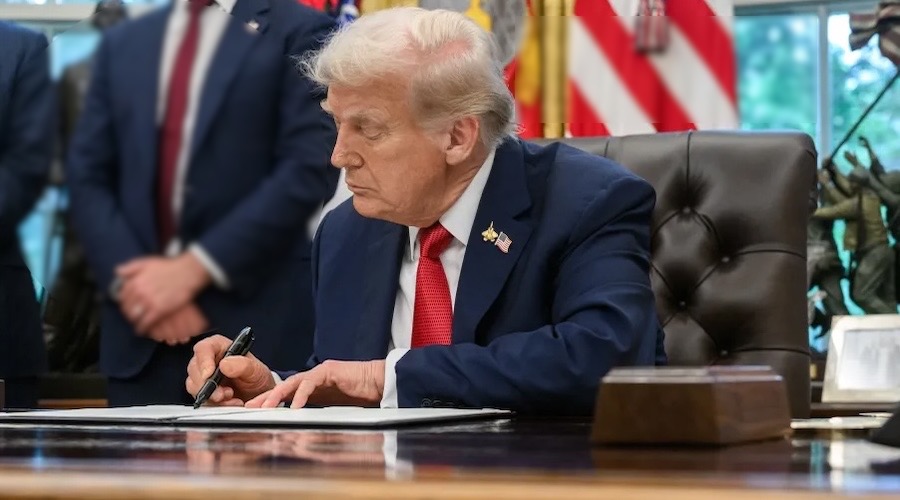
US President Donald Trump is preparing to launch a strategic stockpile of critical minerals backed by $12 billion, aiming to protect manufacturers from supply disruptions as the US accelerates efforts to reduce dependence on Chinese metals.
The White House confirmed on Monday the start of “Project Vault,” which would combine $1.67 billion in private capital with a $10 billion loan from the US Export-Import Bank to buy and store minerals for automakers, technology companies and other industrial users.
The model mirrors the country’s emergency oil reserve but focuses instead on materials such as gallium and cobalt used in products ranging from smartphones to jet engines.
The project spans the automotive, aerospace and energy sectors and underscores Trump’s broader push to rewire US supply chains away from China, the world’s dominant producer and processor of critical minerals.
More than a dozen companies have reportedly signed on, including General Motors Co., Stellantis NV, Boeing Co., Corning Inc., GE Vernova Inc. and Alphabet Inc.’s Google. Commodities traders Hartree Partners LP, Traxys North America LLC and Mercuria Energy Group Ltd. will handle purchases to fill the stockpile.
“Project Vault is a clear signal that US critical‑mineral policy has moved to deployment,” US Critical Materials chairman, Harvey Kaye, told MINING.COM. “It says unequivocally that secure supplies of rare earths and heavy minerals like gallium are now treated as strategic infrastructure for our economy and defense industrial base, to establish US sovereignty.”
Kaye noted that for companies like US Critical Materials, it confirms that high-grade domestic supply is no longer optional.
“The project is exactly the kind of serious, industrial-strength action America needs right now,” Adam Muellerweiss, President of the Responsible Battery Coalition, said in an emailed statement. “Even two years ago, this idea would have been unthinkable. The Trump Administration has made this a national security priority.”
Analyst Dmitry Silversteyn at Water Tower Research said that while the announcement is a step in the right direction, is not a quick solution to China’s control of critical materials. “[I see] continuing to encourage development of domestic and friendly nations’ critical elements resources and metal processing capabilities and infrastructure, as the ultimate and required goal to end, or at least significantly reduce, dependence on China’s goodwill,” he wrote.
Baker Botts lawyer Rebecca Seidl said that for mining and minerals companies, the move is not simply a one-time stockpile but rather a broader shift in federal posture.
“The federal government is preparing to behave like a repeat buyer, market stabilizer, and strategic counterparty, particularly where China’s dominance in mining and processing creates price and availability risk,” Seidl wrote. “As such, projects able to demonstrate reliable production, domestic or allied processing, and credible clean supply-chains will have an easier path to financing and offtake.”
Beyond defence
Trump is scheduled to meet Monday with GM chief executive officer Mary Barra and mining entrepreneur Robert Friedland, representing both consumers and producers of critical minerals.
While the US already maintains a national stockpile for defence purposes, it lacks a comparable reserve for civilian industry. That gap has taken on urgency as the Pentagon ramps up its own accelerated stockpiling campaign, targeting up to $1 billion in mineral acquisitions in the near term.
Unlike the National Defense Stockpile, established in 1939 to support the defence industrial base, Project Vault targets commercial manufacturing. The distinction reflects how mineral supply risks have broadened beyond national security. In 2025, Ford was forced to halt production of its Explorer model due to a rare earths shortage, highlighting the vulnerability of automotive and other industrial supply chains.
Gracelin Baskaran, director of the Critical Minerals Security Program at the Center for Strategic and International Studies in Washington, D.C. says that Project Vault also departs from traditional government stockpiles in its design. The program is demand-led and driven by original equipment manufacturers. Participating companies identify which materials they consider critical, specify required grades and volumes, and commit financially to secure access during market disruptions, Baskaran wrote. The structure aims to provide supply predictability while catalysing domestic mining, processing and refining without direct taxpayer subsidies.
The drive is supported by Trump’s One Big Beautiful Bill Act, which allocates $7.5 billion for critical minerals, including $2 billion to expand the national stockpile by 2027, $5 billion for supply-chain investments and $500 million for a Pentagon credit program to encourage private projects.
The administration has also taken the unusual step of investing directly in domestic mining companies to boost US rare earths production and processing.
Last month, a bipartisan group of US lawmakers introduced a bill to create a $2.5 billion stockpile of critical minerals, a move aimed at stabilizing market prices and encouraging domestic mining and refining.
Senior administration officials told Bloomberg News Project Vault was oversubscribed, citing investor confidence in the credit quality of participating manufacturers, their long-term purchase commitments and the backing of the US export-credit agency. Under the plan, companies can draw down their allotted materials as long as they replenish them, with full access permitted during major supply disruptions.
Manufacturers that commit to buying set quantities at fixed prices will also agree to repurchase the same amounts at the same cost in the future, a structure the administration says will help stabilize prices and dampen market volatility.
Bloomberg News was the first to report the creation of the critical minerals strategic reserve.

{{ commodity.name }}
{{ post.title }}
{{ post.date }}
2 Comments
Robert
The manipulation of Paper Silver price down by the 80 Western bank on 30 January 2026 to a low of $72 an oz was a gift to China to buy all the Silver in Comex and LBMA at a discount.
Robert
Correction: 8 Western Banks.