Copper king Chile faces acid supply crunch as China exports dry up
China’s exports of sulphuric acid to Chile dwindled to zero in March, Chinese customs data show, leaving the world’s top copper producing nation facing a squeeze on supplies of the chemical used to make around half of its refined metal.
The war in the Middle East has caused a sulphur supply crunch, and China is reportedly planning to ban sulphuric acid exports from May to ensure its domestic market – notably the fertilizer industry – does not face a shortage.
But shipments to Chile, which was China’s biggest overseas acid market in 2025 and took almost one-third of its exports, have already dried up, with no acid departing for the South American country last month for the first time since July 2023.
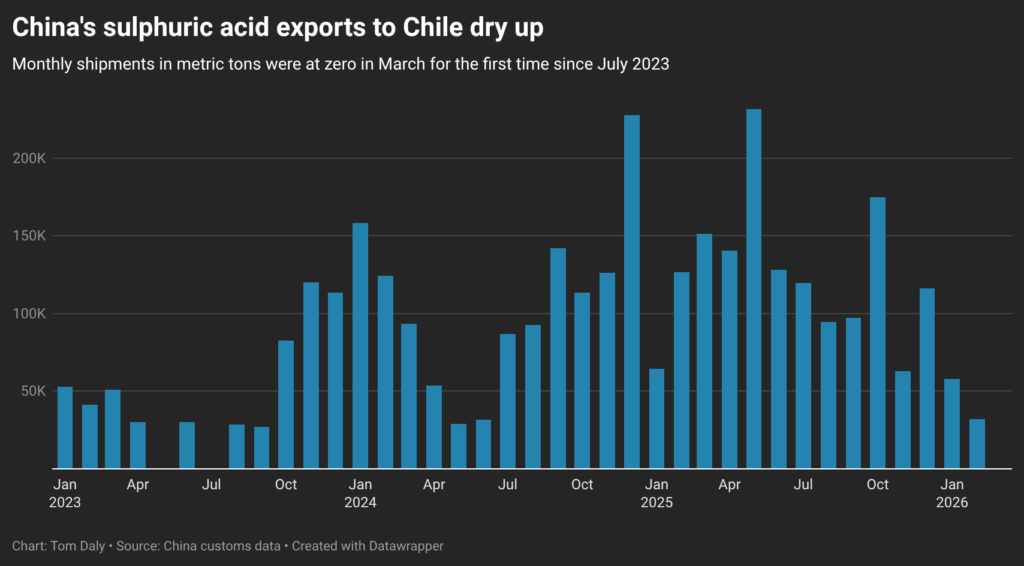
In comparison, China exported 31,870 metric tons of acid to Chile in February 2026 and 151,268 tons in March 2025.
Sulphuric acid is a byproduct of smelting copper ore. But it is also used to produce refined copper via another process known as leaching.
Since Chile does not produce enough acid of its own, it depends on imports, 37% of which come from China, according to HSBC. It thus partly relies on Chinese smelters that purchase its ore to send back the acid for leaching so it can make more metal.
But relations between mining companies and China’s smelters have been strained recently as tight ore supplies have meant treatment charges – the fees paid to process ore – have been heavily in the miners’ favour.
Copper output at risk
“If sulphur supply tightens, acid availability becomes more constrained and expensive,” Alexis Urbani, a sulphuric acid trader with Incotrade Chile, told Reuters.
“That can directly impact cathode production, especially for operations relying on secondary sulphides or lower-grade ores, where acid consumption is higher.”
Morgan Stanley said in a note this month that Chile’s 1.1 million tons of annual leached copper production could be at risk from a Chinese acid export ban. That is over half Chile’s refined copper output of about 2 million tons and one-fifth of its total copper contained production of 5.5 million tons.
“Any impact on output may take time to emerge, however, as leaching is a relatively slow process,” the bank said, estimating that imports from China account for 20% of acid supply for Chilean copper leaching.
China’s overall sulphuric acid exports held steady month-on-month at 143,381 tons in March, with shipments to the Philippines, India and Indonesia all rising sharply.
Chile is particularly vulnerable to supply fluctuations, Bold Baatar – chief commercial officer at Rio Tinto, co-owner of the country’s giant Escondida mine – told a conference on Wednesday.
“The most exposed country is Chile in terms of need for sulphuric acid imports, because that’s where the highest amount of leached copper is,” he said.
(By Tom Daly, Divya Rajagopal, Amy Lv and Polina Devitt; Editing by Joe Bavier)
More News
{{ commodity.name }}
{{ post.title }}
{{ post.date }}
Comments