Copper price declines as Hormuz setbacks cloud peace deal prospects
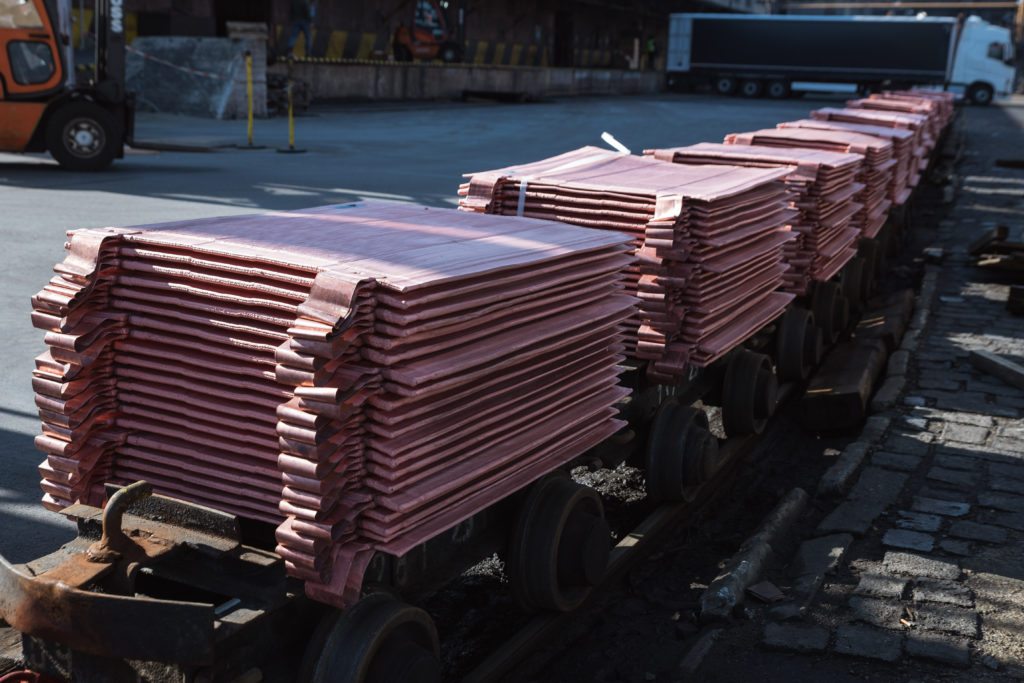
Copper fell after a turbulent weekend in the Middle East threw peace talks between Washington and Tehran into uncertainty just as their fragile ceasefire deadline approaches.
Coming off four weeks of gains, the red metal fell 0.5% to settle at $13,275 a metric ton on the London Metal Exchange, as most industrial metals dropped. Oil climbed on Monday, reversing some of last week’s steep declines, as fears for the global economy once again steered trade across commodities markets.
President Donald Trump said he’s not likely to extend the two-week ceasefire with Iran, increasing the urgency for negotiators to conclude a deal to end the war. Trump said in a Monday phone interview that the truce, which he announced April 7, expires on “Wednesday evening Washington time” — possibly buying more time for negotiations. But the president also said it’s “highly unlikely that I’d extend it” if no deal is reached before then.
Meanwhile, Iran held back from saying whether it would take part in further peace talks even after Trump noted that a delegation was on its way to Pakistan, creating uncertainty about whether a breakthrough can be achieved.
Transits through the Strait of Hormuz have reduced to a trickle amid the war as Iran tightens control in retaliation for strikes.
The major risk for metals is a prolonged closure of the strait, which would magnify the energy shock already rippling through the world economy. That could force central bankers into a more hawkish stance, hitting global manufacturing and damaging demand for industrial commodities.
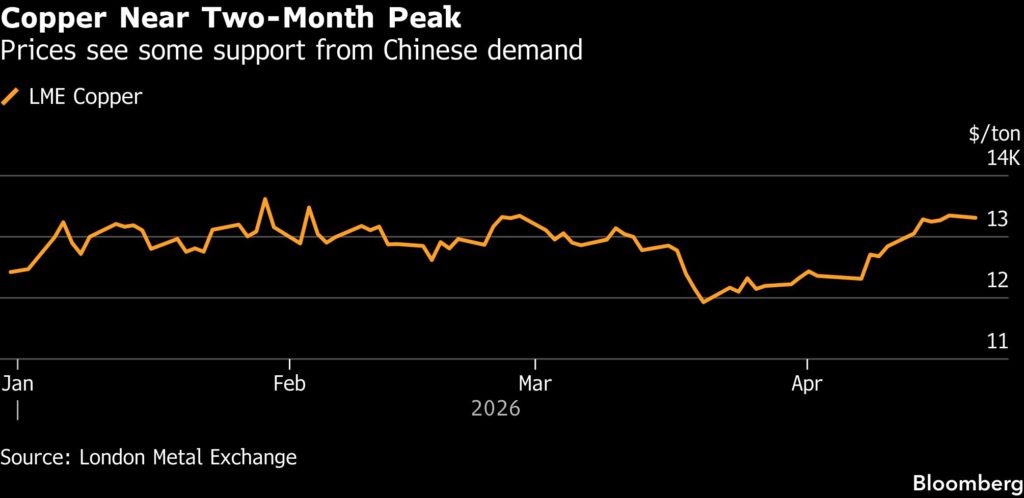
However, prices are getting some support from optimism over demand in China, where inventories have declined rapidly in recent weeks. Stockpiles monitored by the Shanghai Futures Exchange have dropped by almost 200,000 tons since this year’s peak on March 13.
“We are currently in peak consumption season in China, and demand has maintained a high growth rate,” said Jia Zheng, trading manager at Suzhou Chuangyuan Harmony-Win Capital Management Co. “China’s copper prices have begun to move away from the impact of the situation in the Middle East.”
Aluminum slipped further on Monday. The dynamic in the aluminum market has been different from other base metals because the conflict has forced smelter closures and production cuts across the Middle East, pushing up prices.
The so-called US Midwest premium — the amount added to global benchmarks to deliver aluminum to that region — rose to a fresh record of $1.14 a pound on Monday, according to Fastmarkets data.
“Reopening the Strait is essential to allow producers to restock raw materials and export finished products that have been largely stranded at smelters,” the International Aluminium Institute said in an emailed statement. “This is now having a knock-on impact on supply-chains extending as far as Australia which supplies alumina to some of the Gulf smelters.”
Aluminum production in Gulf countries dropped 6% to 15,963 tons a day in March, the organization said, noting that it doesn’t yet have production figures for all its members’ smelters in the region.
Aluminum fell 0.2% to settle at $3,557.50 a ton on the LME. It’s still up 13% since the war broke out in late February.
Read More: Iran war’s sulfurous fallout spreads to copper and nickel
{{ commodity.name }}
{{ post.title }}
{{ post.date }}
Comments